Pattachitra of Odisha: The Painting That Stands In When the Gods Cannot Be Seen
Tamarind-gum cloth, conch-shell white, and the strict geometry of Puri: how an entire school of painting was created to replace the Lord during his sacred illness.
The Origin & Regional Context
In the coastal temple town of Puri, painting is not an accessory to the temple; it is an emergency liturgical necessity.
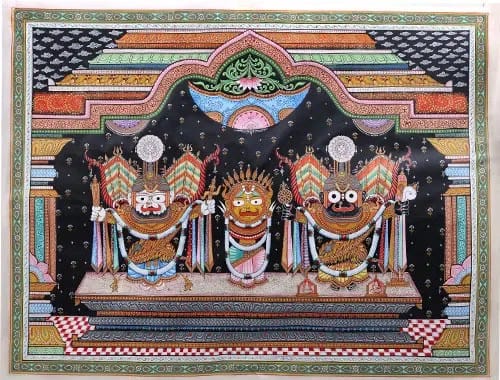
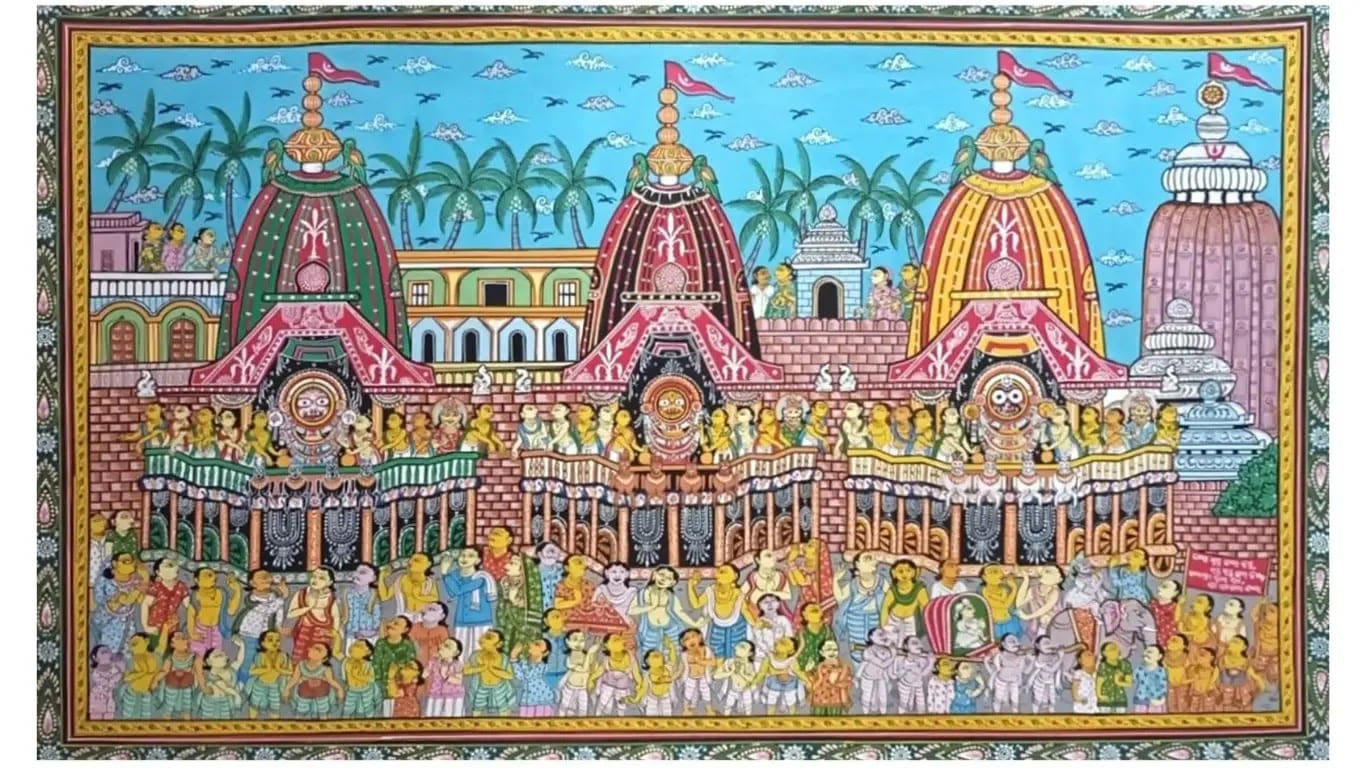
Every year, following the scorching full moon of the Snana Yatra (the grand bathing ritual), the presiding deities of the Jagannath Temple, Jagannath, Balabhadra, and Subhadra, contract a ceremonial fever from their sacred bath. For a fortnight known as Anasara, the sanctum sanctorum is locked shut. The carved wooden deities are taken into secluded convalescence, invisible to pilgrims. To ensure the temple does not sit empty, hereditary temple painters known as Mahapatras and Chitrakaras deliver the Anasara Patti, three monumental cloth paintings depicting the deities in their classic iconographic forms.
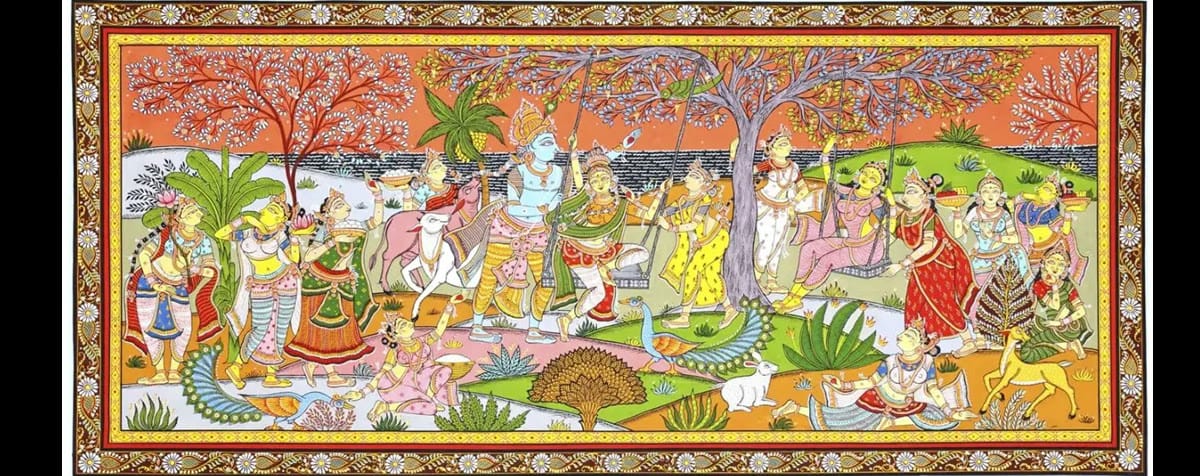
While the temple cloth remains anchored to the Jagannath trinity, the hereditary village of Raghurajpur, tucked along the Bhargavi river near Puri, channeled this sacred cloth technology into the lilas of Braj. In Odisha, Krishna is not separate from Jagannath; he is his living, dancing breath. Through the verses of the 12th-century poet Jayadeva, who wrote on the banks of the Prachi river, the Chitrakaras covered thousands of square yards of cloth with the romance, separation, and union of Radha and Krishna.
Visual Grammar & Iconography
Pattachitra does not yield to modern realism. It is governed by a strict, architectural visual canon (Chitra Sutra):
- The Unbroken Floral Border (Dhaadi). Every Pattachitra begins with the edge. Before the god is born on the cloth, the artist paints an intricate, multi-layered frame of vine scrolls, creepers, and stylised lotuses. This border acts as a consecrated threshold, separating the sacred space of the painting from the mundane world.
- The Sweeping Fish-Eye (Matsyakara). Figures are drawn in sharp profile or three-quarter view with enormous, arched fish-shaped eyes that extend toward the ear. The nose is prominent and sharp, the chin compact, and the lips curved into a faint, knowing smile.
- Dynamic Posture (Bhangi). Radha and Krishna are rarely stiff. Krishna stands in the classic Tribhanga, the three-fold bend of the body at neck, waist, and knee, expressing rhythm, grace, and music. The gopis around them are composed in dynamic diagonal tiers.
- The Composite Forms (Nari-Ratha & Navagunjara). Pattachitra is famous for its intricate visual riddles:
- Kandarpa Ratha. Nine gopis twisting their limbs together to form the wheels, canopy, and frame of a royal chariot carrying Radha and Krishna.
- Navagunjara. A mythical composite beast composed of nine different animals, rooster’s head, peacock’s neck, bull’s hump, snake’s tail, tiger’s waist, and an elephant’s leg, confronting Arjuna in the forest as Krishna’s cosmic form.
Material Anatomy & Process
- The Canvas (Patta). Two layers of discarded cotton cloth (often worn-out cotton dhotis) are laminated together using a paste made of boiled tamarind seeds (kaitha katha). Once dried, the surface is coated on both sides with soft clay mixed with crushed limestone, then burnished vigorously with rough and smooth river stones (khaddar) until it feels like stiff parchment.
- The Maritime White (Sankha). The master white is derived from calcined conch shells harvested from the shores of Puri, ground by hand in stone mortars for days until reduced to a micro-fine powder. It gives Pattachitra its characteristic luminescent, porcelain white.
- Mineral Pigments
- Red. Crushed cinnabar stone (hingula).
- Yellow. Raw mineral orpiment (haritala).
- Black. Carbon lampblack gathered from the smoke of burning castor-oil clay lamps.
- Blue. Ground lapis lazuli and natural indigo.
- The Final Lacquer Over Fire (Jaula). A completed Pattachitra is never finished with varnish. Natural tree resin (jaula) is dusted over the face of the painting, and the cloth is held face-down over glowing charcoal embers. The melted resin seals the mineral pigments into the fibers, rendering the entire scroll water-resistant and giving it an enamel gloss.
The Literary & Spiritual Roots
Pattachitra’s devotional engine is Jayadeva’s Gita Govinda.
In the 12th century, Jayadeva composed his twelve-canto Sanskrit poem at Kenduli Sasana near Puri, setting it to classical Odissi ragas to be performed exclusively inside the Jagannath Temple. The Chitrakaras took Jayadeva’s written verses and transformed them into the Gita Govinda Pata, twenty-four horizontal panels charting the drama of Viraha (the agony of separation) and Sambhoga (the ecstasy of divine union).
In Odisha, Krishna’s childhood in Braj is lived through intense, physical rhythm: he is the dark cowherd whose flute controls the tides of the sea, the thief of curds who challenges the cosmic order, and the divine lover whose feet Radha cleans with her tears.
Heritage, Lineage & Field Notes
- The Living Village of Raghurajpur. Declared India’s first "Heritage Crafts Village" in 2000, Raghurajpur is an open-air studio where every home belongs to a Chitrakara lineage. The artists maintain traditional guild hierarchies (Pata Akhara), training apprentices from childhood in the unbroken discipline of the brush.
- Geographical Indication (GI) Status. Odisha Pattachitra holds official Geographical Indication status under the Geographical Indications of Goods Act (Registered under Application No. 87 in 2008), legally certifying its unique artistic heritage to the artisan families of the region.
- Key Archival Repositories
- Odisha State Museum, Bhubaneswar. Premier collection of palm-leaf Tala Pattachitra and historic Anasara Patti cloths.
- National Museum, New Delhi. Master narrative Pattachitra scrolls illustrating the Gita Govinda.
- Ashmolean Museum, Oxford. Archival 18th-century Puri temple banners.
Pattachitra was not invented for the eyes of connoisseurs. It was painted so that when God closed his doors to heal, the devotee would never have to look upon an empty altar.