Guler Painting: The Quiet Cradle of the Pahari Lineage
Soft river mists, trembling willow boughs, and the delicate gaze of the lover: how a small hill kingdom softened the fires of the mountains into lyrical poetry.
The Origin & Regional Context
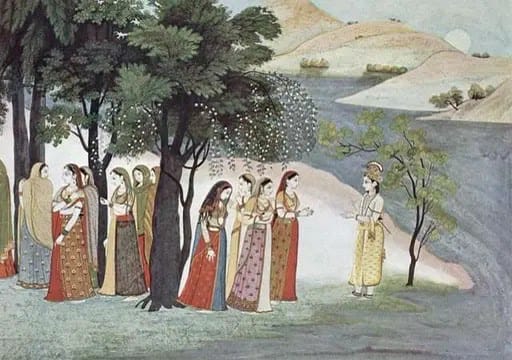
Nestled in the lower Shivalik hills where the river Banganga snakes through lush terraces, the principality of Haripur-Guler was historically referred to by art historians as the birthplace of Pahari art. While Basohli to the north painted divine love with flat planes of fiery cinnabar and dramatic intensity, Guler chose an entirely different emotional path: contemplation, delicate naturalism, and rhythmic tenderness.
The stylistic revolution began in the early 18th century under Raja Dalip Singh (r. 1695-1741) and matured under his son, Raja Govardhan Chand (r. 1741-1773). Guler provided safe sanctuary to master artist families migrating from the deteriorating Mughal capital in Delhi. Yet, these artists did not merely reproduce imperial court etiquette. They submerged their refined Mughal techniques into the deep Vaishnava devotion of the hills. Under the riverine mists of Guler, Braj was reimagined not as an imperial fortress, but as a pastoral sanctuary of weeping willows, calm brooks, and quiet mountain balconies.
Visual Grammar & Iconography
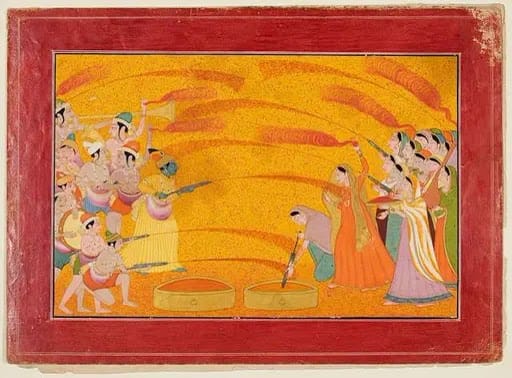
Guler painting is defined by fluid draftsmanship, restraint, and an acute sensitivity to human vulnerability:
- The Gentle Oval Profile. Unlike the sharp receding foreheads of Basohli or the exaggerated pointed features of Kishangarh, the Guler profile is soft, natural, and oval. The bridge of the nose has a gentle, natural contour, paired with delicate almond eyes that gaze downward with bashful devotion (lajja).
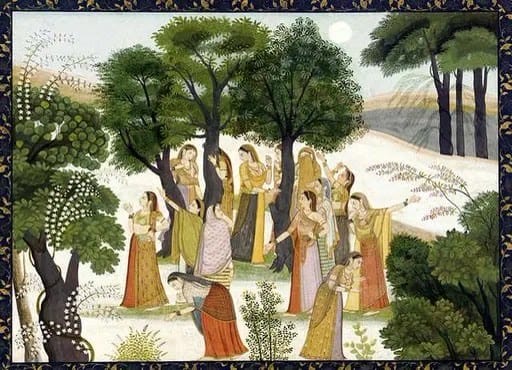
- Atmospheric Nature as Living Emotion. Nature is observed with lyrical accuracy. Weeping willows sway gently over water, plantain leaves bend under imaginary breezes, and flowering creepers climb gnarled tree trunks. In Guler, nature does not storm or shout; it breathes softly in harmony with the lovers.
- The Pastel Symphony. The color palette abandons hot, jarring contrasts. Guler painters mastered subtle modulations of cool slate grays, sage greens, pale lilac, unbleached ivory, and soft sky blues, punctuated by the glowing saffron of Krishna's garments.
- Architectural Intimacy. White marble balustrades, open octagonal terraces, and simple low wooden fences frame the figures, ensuring that the composition remains quiet, balanced, and domestic.
Material Anatomy & Process
The lyrical elegance of Guler folios was achieved through rigorous studio craft:
- The Wasli Sheet. Several sheets of handmade Sialkoti paper were laminated together using starch paste infused with neem leaves to deter insects. The surface was rubbed with a smooth agate burnisher until the paper took on the texture of eggshell.
- The Squirrel-Hair Brush (Kalam). The remarkable softness of Guler lines relied on brushes made from delicate hairs plucked from the belly of local Himalayan squirrels, enabling steady, hair-thin outlines without ink pooling.
- The Mineral Kitchen
- Blue. High-grade natural lapis lazuli, washed repeatedly to yield translucent sky blues and misty river tones.
- Green. Soft terra verde (green earth) mixed with touches of orpiment yellow to create delicate foliage tones.
- Yellow & Flesh Tones. Muted ochres, turmeric, and refined chalk white blended into realistic, luminous skin tones.
- Black. Refined carbon soot from burnt mustard-oil lamps.
The Literary & Spiritual Roots
Guler miniatures were visual meditations on classic devotional poetry:
- The Bhagavata Purana Suites. Guler masters produced comprehensive illustrated suites of the Tenth Book of the Bhagavata Purana, chronicling the birth, cowherd games, and pastoral lilas of Krishna.
- Jayadeva's Gita Govinda. The lyrical verses of the Gita Govinda were interpreted through deep domestic tenderness. Krishna is depicted not as an aloof cosmic deity, but as a devoted companion kneeling to adjust Radha’s anklet or braid wild forest blooms into her dark hair.
- The Mood of Intimacy (Madhurya). The guiding theology of Guler is Madhurya Rasa, the sweet, quiet experience of God as an equal lover, where majesty is completely dissolved in affection.
Heritage, Lineage & Field Notes
- The Master Workshop of Pandit Seu. Guler was the ancestral home of Indian miniature painting's most influential dynasty. Patriarch Pandit Seu and his sons, Manaku and Nainsukh, perfected their early craft here. While Manaku preserved the devotional weight of traditional narratives, Nainsukh infused the court with observational realism, creating the visual seed that later blossomed into the Kangra school under Sansar Chand.
- The Transition to Kangra. When royal patronage in Haripur-Guler declined in the late 18th century, descendants of this family workshop migrated to Kangra, Chamba, and Mandi, carrying the Guler kalam across the entire Pahari landscape.
- Key Archival Repositories
- Government Museum and Art Gallery, Chandigarh. Foremost collection of early Guler folios, collected by Dr. M.S. Randhawa.
- National Museum, New Delhi. Master folios from the Guler Bhagavata Purana and Gita Govinda.
- Metropolitan Museum of Art, New York. Dispersed master sheets from Pandit Seu's workshop.
In Guler, the painters proved that the highest devotion does not need to raise its voice. It lives in the quiet angle of a head, the bend of a willow, and the still surface of mountain water.