Madhubani Painting of Mithila: How a Room Painted for a Wedding Night Became a World Art
For centuries the women of Mithila painted rooms no outsider would ever enter, in colours meant to be washed off by the next monsoon. It took an earthquake, and then a drought, to carry those walls out of the house.
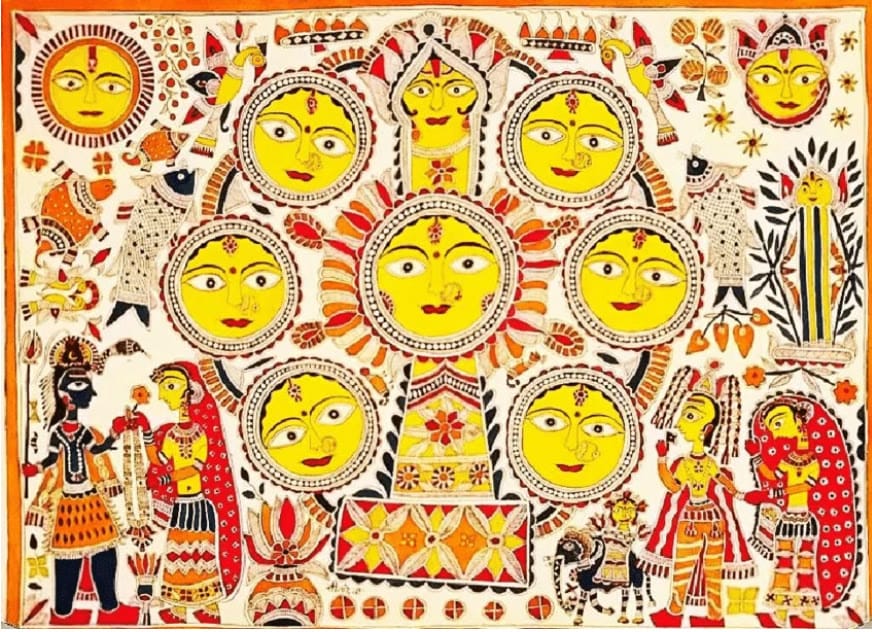
The Origin & Regional Context
Mithila is the plain of north Bihar — Madhubani, Darbhanga, Sitamarhi, Samastipur, Supaul, Saharsa — running across the border into the Nepal Terai around Janakpur. It is ancient Videha, the kingdom of Janak, and it has never treated the Ramayana as a story from elsewhere. The painting was domestic, ritual, female and deliberately temporary: bhitti-chitra on walls freshly plastered with mud, cow dung and rice husk, and aripan drawn on the floor in rice paste with the fingers. It was made for weddings, births, vrats and festivals, renewed when the surface was renewed. Nothing was signed, nothing sold, nothing written down — a daughter learned the motifs and their order by painting beside her mother.
The outside world learned of it by accident. On 15 January 1934 a severe earthquake struck Bihar and Nepal; William G. Archer, a British officer posted at Madhubani, found that collapsed outer walls had exposed painted interiors he had never seen, photographed them, took away about twenty versions made for him on paper, and published an account in the journal Marg in 1949. The second turn was economic. After the drought and famine of 1966–67, Pupul Jayakar at the All India Handicrafts Board sent the artist Bhaskar Kulkarni to persuade women to move their wall paintings onto handmade paper so the work could be sold. He found his first painters in Jitwarpur and Ranti; a Delhi exhibition followed in 1967, and from 1970 the paintings travelled abroad.
Visual Grammar & Iconography
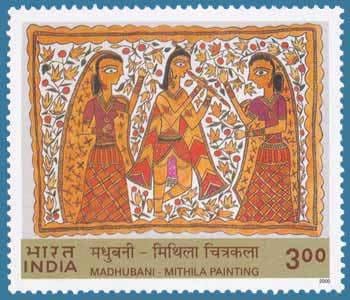
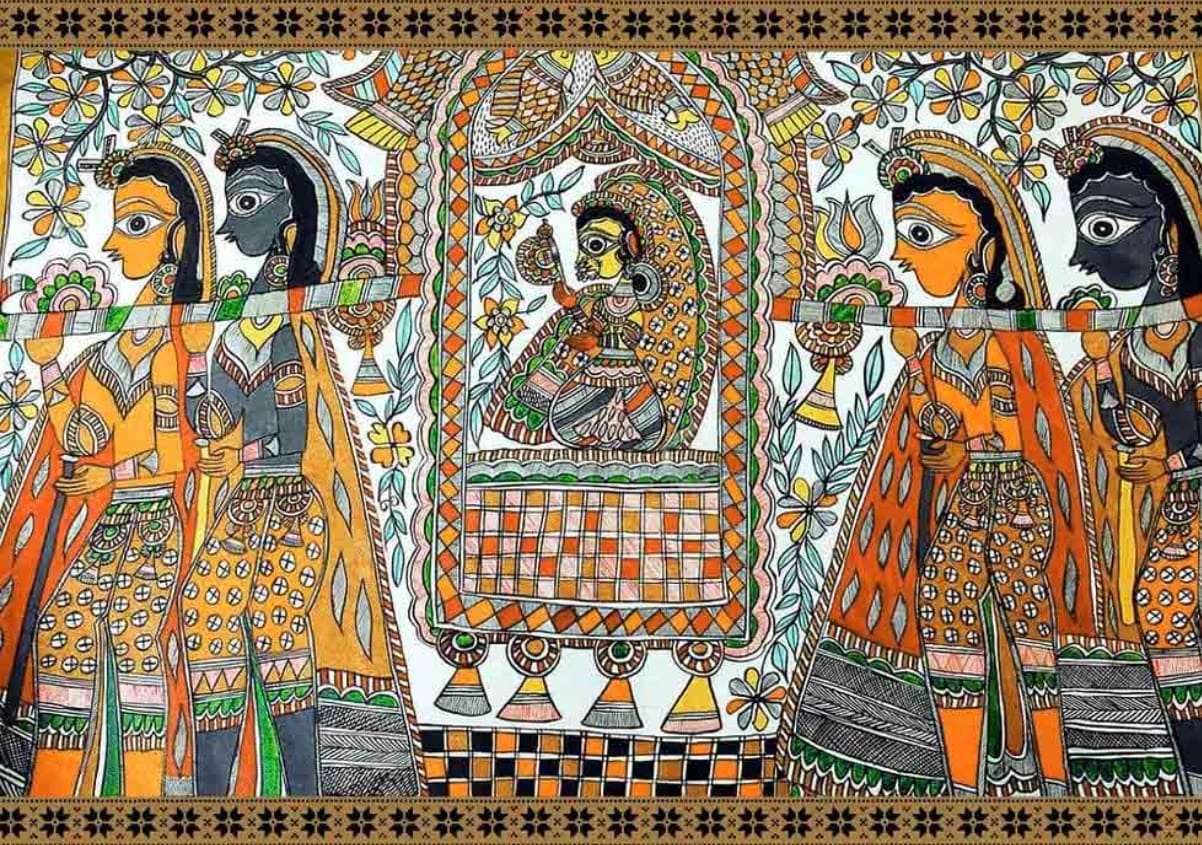
A composition is closed by a doubled line with pattern running in the channel between, and inside it no ground is left bare — every gap fills with flowers, fish, birds, sun-wheels or geometry. There is no perspective and no modelling; figures are scaled by importance, and the face is given in profile with a single very large fish-shaped eye that carries most of the expression. The filling is not a habit of style: on a ritual wall an empty space is an opening, and the border and the fill are what close the image.
Five manners run through the tradition. Bharni floods bold black outlines with solid colour and was historically painted by Brahmin women; kachni withholds colour and builds the image in fine hatching, historically the style of Kayastha women; tantrik handles the Mahavidyas and yantras; godna, derived from tattoo, was developed by Dusadh women around their own hero-deity Raja Salhesh; kohbar is the painting made for the nuptial chamber. At the kohbar’s centre stands the purain, the lotus pond read as the feminine principle, set against a bamboo grove read as the masculine and as the continuing of the line, with fish, parrots, tortoise and elephant around them, naina-jogin figures guarding the edges, and the sun and moon as witnesses at the upper corners.
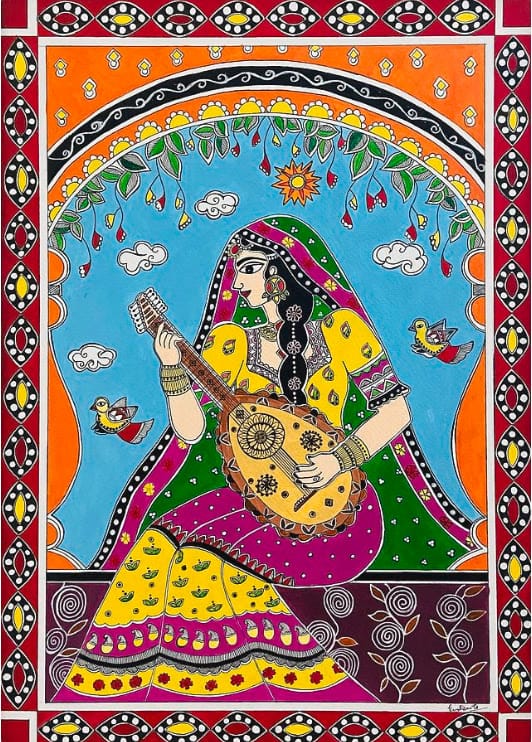
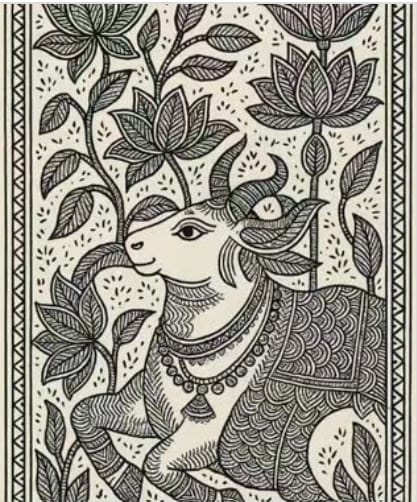
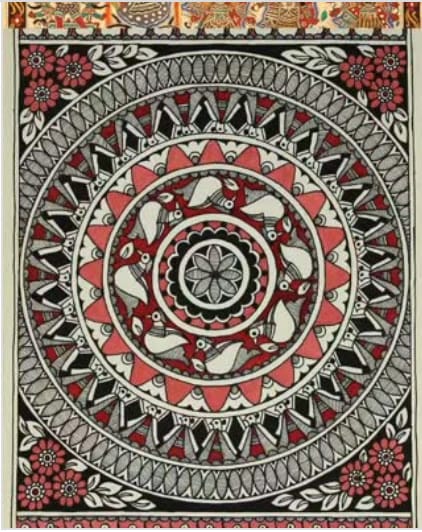
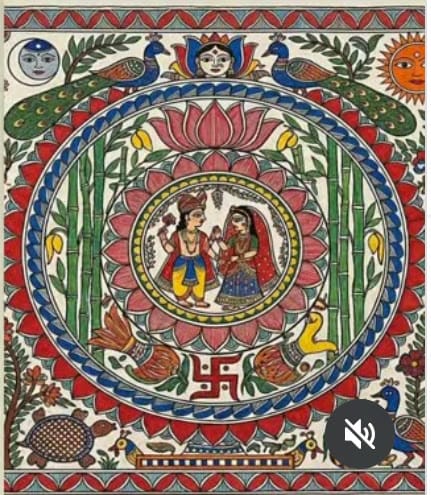
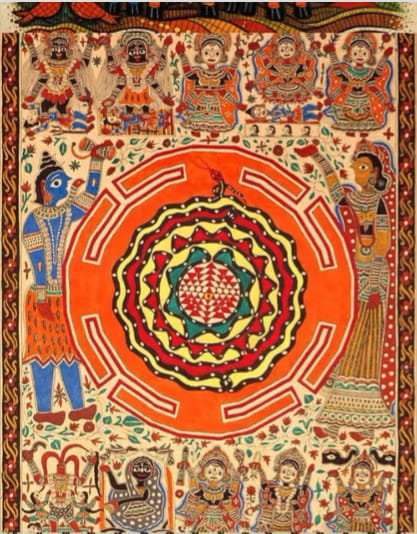
Colour came from the kitchen and the courtyard: kajal soot for black, turmeric for yellow, palash for orange, kusum flower and sindoor for red, bel and banana leaf for green, indigo for blue, rice paste for white, with a thin cow-dung wash toning the ground of the paper. Pigments are bound with babul gum and sometimes goat’s milk.
Material Anatomy & Process
- The surface. Mud plaster laid fresh on the wall; from the mid-1960s, handmade paper toned first with a cow-dung wash so it does not read as a blank sheet. Cloth and canvas followed.
- The brush. A bamboo twig frayed at the tip, a matchstick with a wisp of cotton wound at one end for the finest kachni hatching, a rag or the fingers for broad fills. Much of the tradition has never used a manufactured brush.
- The sequence. Outline first in black, drawn directly with no under-sketch and no correction possible; then the fill, then the border, then the pattern that closes whatever space is left. The order is fixed and is part of what a daughter learns.
The Literary & Spiritual Roots — the poetry behind the painting
- Vidyapati. Born around 1374 at Bisfi in what is now Madhubani district, court poet to Shivasimha, who granted him his home village on a copper plate naming him the new Jayadeva. He wrote in Sanskrit, in Avahattha and decisively in Maithili, and his padavali of Radha and Krishna songs made Maithili a literary language.
- Song and hand together. Mithila’s women sing while they paint — wedding songs, seasonal songs, and Vidyapati’s padas among them. The singing is not accompaniment; it names what the hand is drawing. A written tradition is corrected by a text, this one by a song, which is how a wholly oral and domestic art kept its vocabulary intact for centuries.
- The Ramayana as local history. Sita is a daughter of the soil here, found in a furrow Janak ploughed, and the region’s account of its own painting begins with Janak having his city painted for her marriage. Every Maithil wedding restages a wedding Mithila believes it hosted, and the kohbar is the room where it happens.
Heritage, Lineage & Field Notes
- The lineage of names. Jagdamba Devi took the National Award in 1970 and in 1975 became the first Mithila painter to receive the Padma Shri. Sita Devi of Jitwarpur (1914–2005) followed in 1981, Ganga Devi — the great exponent of kachni — in 1984, Mahasundari Devi of Ranti in 2011, Baua Devi in 2017, Godawari Dutta in 2019 and Dulari Devi in 2021.
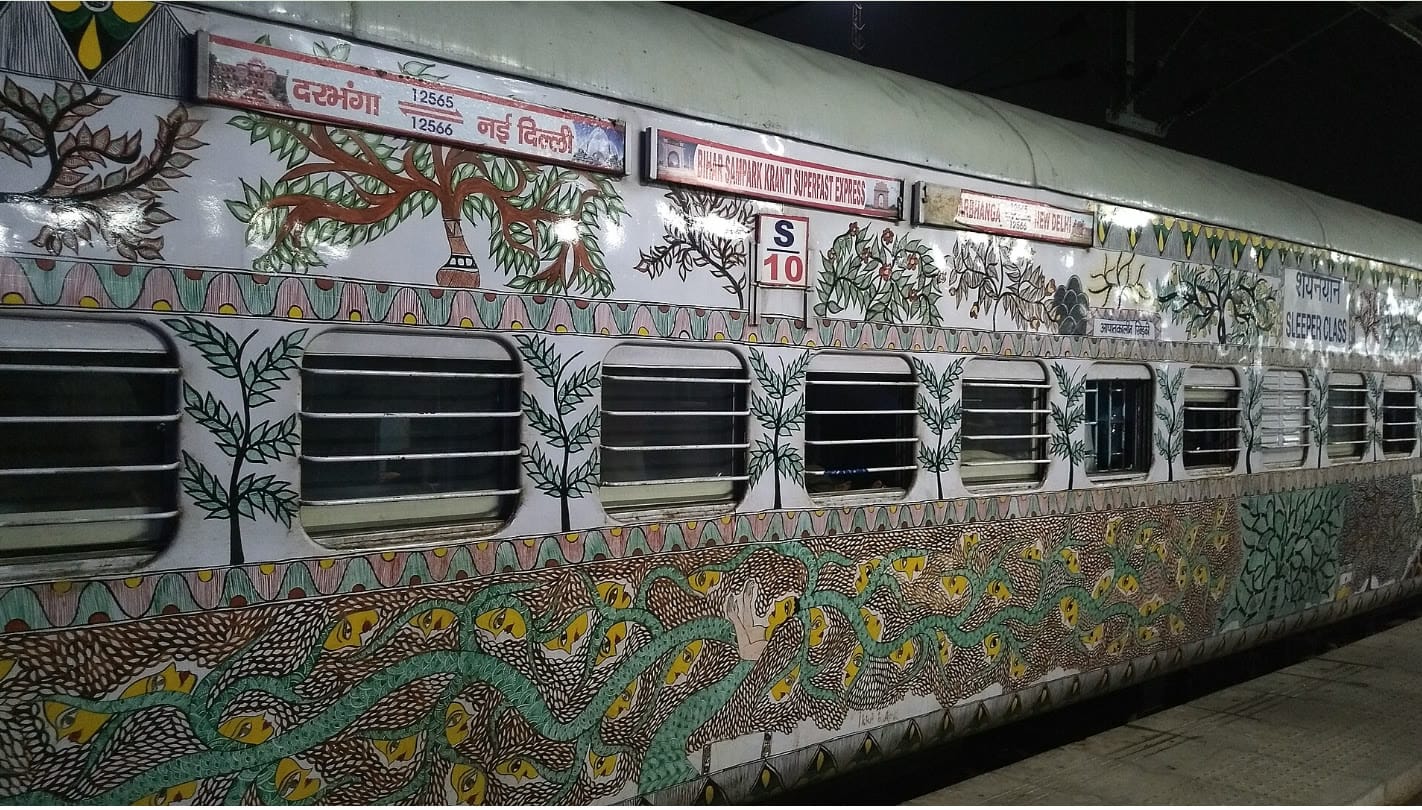
- Back on a public wall. From the 1990s the form absorbed contemporary subjects without losing its grammar. In 2012 artists painted tree trunks with gods to stop them being felled, and in October 2017 around two hundred artists painted over 7,500 square feet of Madhubani railway station without charging for the work.
- GI and how to read one. Madhubani painting was registered as a Geographical Indication in 2007. Ask which of the five styles a painting is in — a seller who cannot say is describing the district, not the work. Natural colour, a drawn double border, no empty ground and lines made with a twig are the marks of the traditional method.
The wall was always going to wash away. That was never the point.