Bundi Miniature Painting: How a Desert Dynasty Reimagined Braj in the Rains
Lush riverine thickets, lightning dancing across dark indigo skies, and Radha waiting on a palace terrace: how a desert dynasty painted the scent of rain.
The Origin & Regional Context
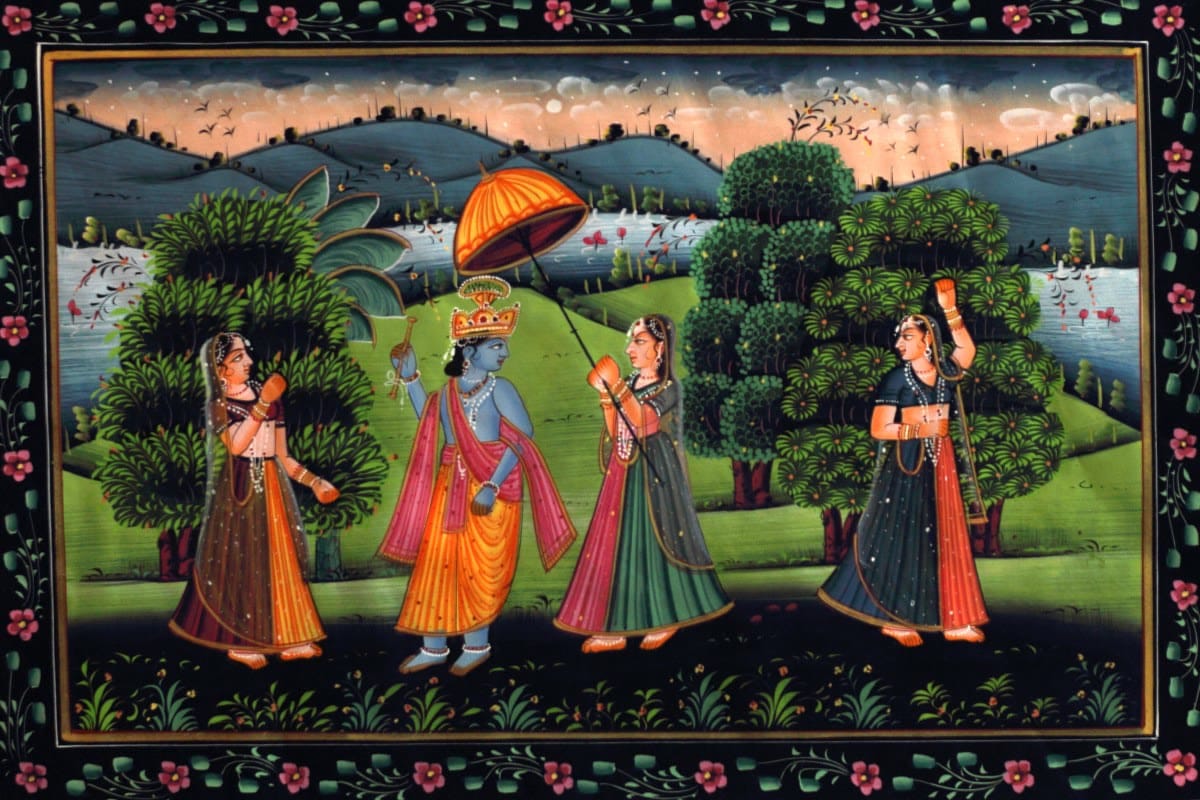
Cradled in the rocky, fortified gorge of the Aravallis, the Hada Rajput state of Bundi was historically defined by rugged martial strength. Yet, within its secluded palace apartments, the court cultivated the most sensuous, water-drenched school of painting in all of Rajasthan.
While neighboring Mewar painted in flat, bold blocks of crimson, Bundi turned its gaze entirely to nature's atmospheric cycles. The school took root in the late 16th century following the Mughal alliance under Rao Surjan Singh, but it developed its true voice when it cast aside imperial court formality to embrace the emotional fervor of Braj. In Bundi, Vrindavan is neither a dry desert scrubland nor an idealized garden; it is a wild, overgrown jungle pulsing with monsoon rain, where the air is heavy with moisture and the cry of peacocks heralds the arrival of the cowherd god.
Visual Grammar & Iconography
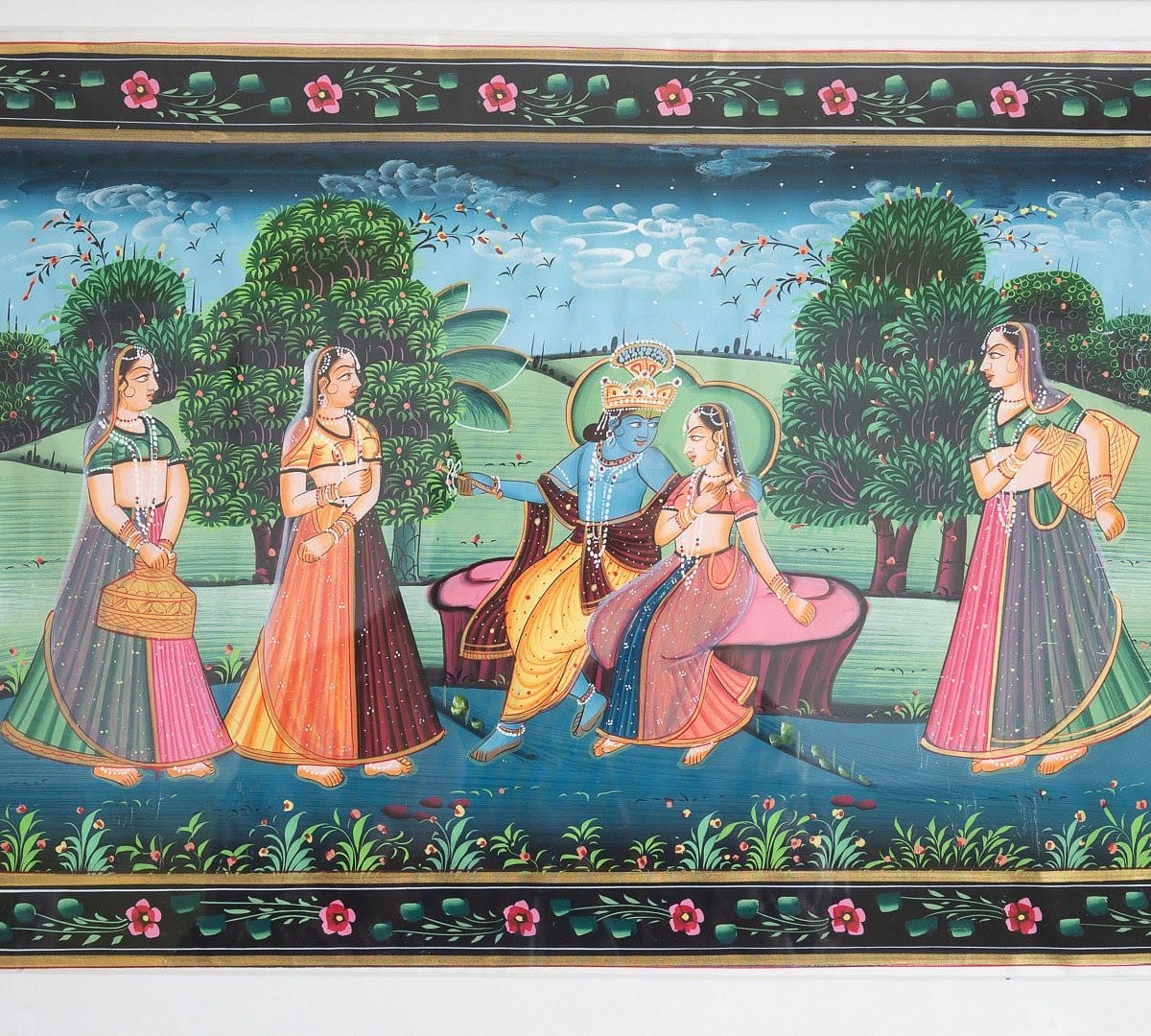
Bundi painting possesses an immediately identifiable sensory intensity:
- The Dramatic Heavens. Bundi masters did not paint flat blue skies. Their skies are layered, turbulent theaters: billowing indigo and charcoal-gray monsoon clouds with gold-rimmed edges, pierced by jagged, ribbon-like streaks of pure golden lightning.
- The Dense, Tiered Flora. The background is choked with living vegetation. Slender, spiraling betel palms, broad drooping plantain leaves, flowering mango boughs, and fragrant Kadamba trees are stacked in lush, vertical planes, showing nature closing in around the divine lovers.
- Physiognomy & Complexion. Figures possess round, full faces, pronounced cheeks, pointed chins, and warm, expressive almond eyes. Radha is often shown in a short, translucent blouse (choli) and gossamer veil (odhani), while Krishna’s body is painted in deep, luminous lapis-tinted blue.
- The Silver Needles of Rain. Rain is rendered not as mist, but as distinct, fine, rhythmic vertical white lines drawn with single-hair brushes over darker grounds, falling into rolling river currents laden with leaping fish and waterbirds.
Material Anatomy & Process
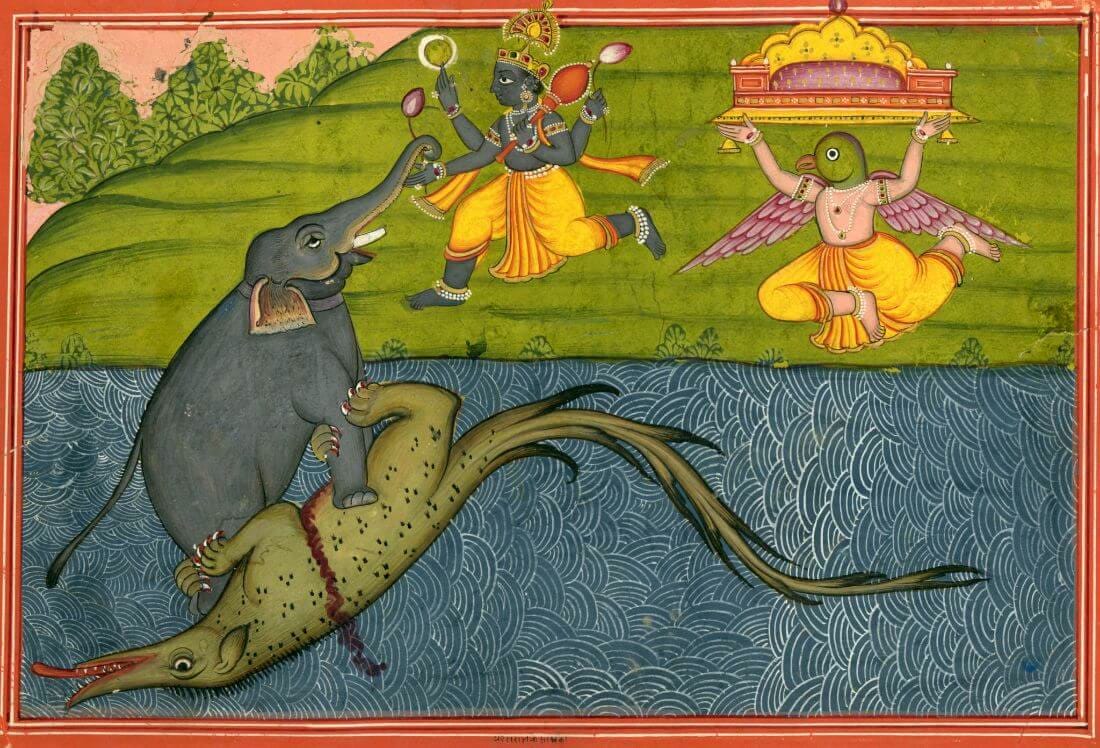
Bundi folios achieved their saturated, lacquer-like depth through specific material chemistry:
- The Saturated Green Earth. Bundi’s lush jungle backdrops relied on thick layers of terra verde (green earth) and powdered malachite, often glazed with botanical green saps to give the foliage an eternal, wet sheen.
- Lapis & Indigo Water. Streams, ponds, and heavy rain clouds were laid down using high-grade lapis lazuli mixed with deep plant indigo, burnished to an enamel finish.
- Gold Foil & Droplets. Lightning, palace cupolas, jewelry, and textile hems were detailed using real gold leaf (vark) and thick droplets of Shell Gold (purified gold ground into gum), which catch the light like wet rain.
- Wasli Preparation. Smooth, burnished wasli paper, repeatedly polished with an agate stone, allowed artists to lay delicate, needle-thin white rain tracks without the pigment feathering into the paper fibers.
The Literary & Spiritual Roots
Bundi’s emotional engine is anchored in the poetry of separation and the seasons:
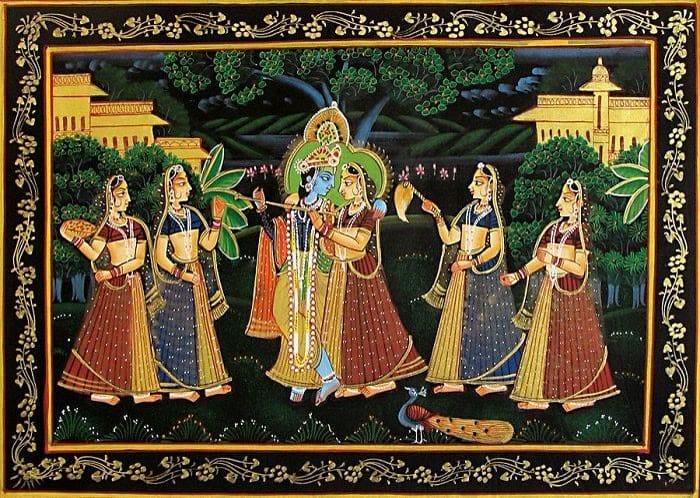
- Keshavdas’s Rasikapriya & Kavipriya. Bundi ateliers illustrated extensive cycles of the court poet Keshavdas of Orchha. His verses classify the psychological moods of love, using the Nayika Bheda framework to capture Radha’s longing, jealousy, and sweet reconciliation (Maan).
- The Barahmasa (Poetry of the Twelve Months). The song of the seasons was central. During the suffocating summer (Jyeshtha), Krishna and Radha seek cool river breezes; during the thundering monsoon (Sawan and Bhadon), separation becomes physically unbearable, and the lovers are compelled to unite under the roaring skies.
- Devotional Mood. Bundi embodies Sambhoga Sringara (love in joyful union) heightened by the dramatic contrast of the stormy wilderness outside.
Heritage, Lineage & Field Notes
- The Bundi-Kota Divergence. In the early 17th century, Kota split from Bundi. While Kota took the inherited style and turned it outward toward grand, wild hunting spectacles in the ravine jungles, Bundi preserved its focus inward, remaining the undisputed master of domestic romance and lyrical rain.
- The Chitrashala Frescoes. The peak of this tradition can still be witnessed in situ at the Chitrashala (Ummed Mahal) within the Bundi Garh Palace: a colonnaded gallery completely covered in 18th-century wall paintings of Krishna lifting Mount Govardhan, swimming with gopis, and dancing the Raas-Lila.
- Key Archival Repositories
- Chitrashala, Bundi Palace (Rajasthan). Monumental intact wall-painting cycles.
- National Museum, New Delhi. Extensive holdings of Bundi Barahmasa and Rasikapriya folios.
- Victoria and Albert Museum, London. Early 17th-century Chhattar Sal period folios.
In Bundi, nature does not wait for spring to bloom. It bursts open the moment Krishna looks back at Radha beneath the storm.