Basohli Miniature Painting: How a Sanskrit Bouquet of Verses Became a Court of Colour
In a hill town on the Ravi, a court atelier took a Sanskrit poem written for the ear and gave it a face, a room, a season and a colour — and gave Pahari painting its first distinct voice.
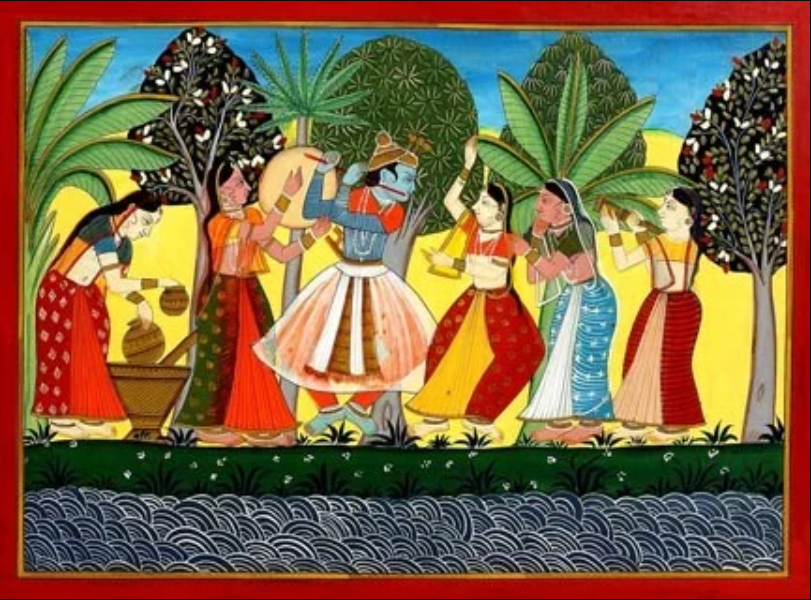
The Origin & Regional Context
Basohli painting takes its name from Basohli, a small hill town on the banks of the river Ravi, in what is today the Kathua district of Jammu, at the point where the Shivalik foothills begin their climb toward the higher Himalayas. The town itself — founded in 1635 by Raja Bhupat Pal under the older name Vishwasthali — grew within a generation into the seat of a court whose painters would give the entire Pahari miniature tradition its first distinct voice.
That voice took shape under Raja Kirpal Pal, who ruled Basohli through the final decades of the seventeenth century. Kirpal Pal kept a royal atelier and held a particular fascination for illuminated manuscripts, and it was this atelier — under the painter Kripal, his son Devidasa, and Devidasa's son Golu — that produced the earliest surviving Basohli work: a series illustrating the Rasamanjari, datable to the 1680s and 90s.
Here, an act of translation took place. A Sanskrit poem written for the ear was given a body for the eye: verses that had circulated for centuries as recitation and commentary were, for the first time, assigned a face, a room, a season, and a colour. The hill court could not always follow classical Sanskrit, but it could read a raised hand, a lowered gaze, a darkening sky — and it was this act of turning poetic description into pictorial fact that was the Basohli atelier's founding contribution to Indian painting.
Visual Grammar & Iconography
The signature profile
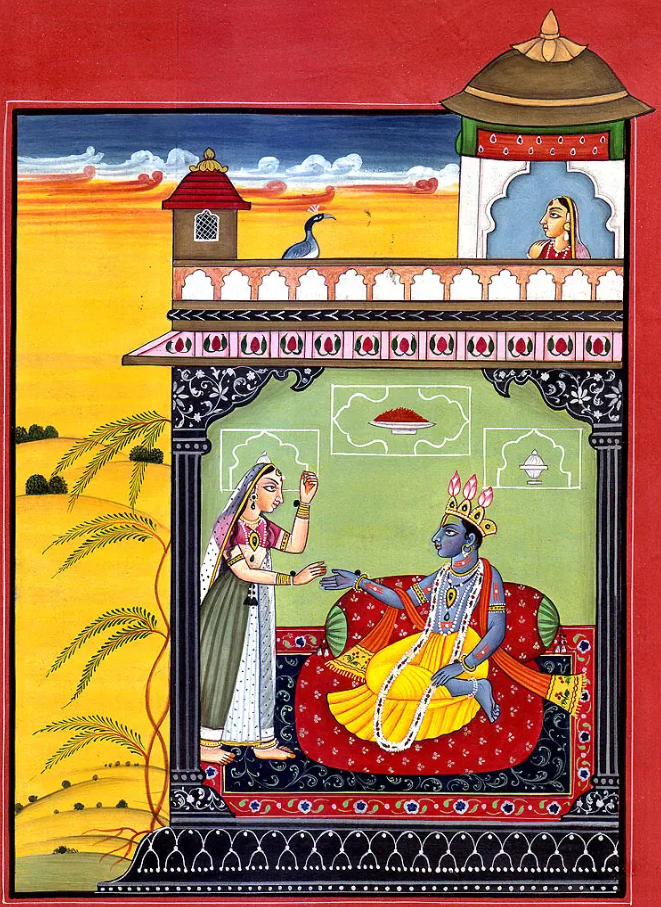
Basohli figures are drawn with a wide, receding forehead that runs almost without a break into a straight nose, set beneath large, almond-shaped eyes that dominate the face — a feature so pronounced that the eye itself, rather than the whole countenance, carries most of the painting's emotional charge. Faces are shown in strict profile or a tight three-quarter turn, chins are small and rounded, and figures are built compactly, often monumental in scale against a shallow, high-horizoned setting.
The emotional vocabulary — rasa and bhava
Basohli's founding text is literally named for this idea: Rasamanjari means a bouquet, or flower-spray, of rasa — the aesthetic essence a poem or painting is meant to distil. Each folio was built to carry one dominant Sringara Rasa, the sentiment of romantic love, expressed through a heroine's precise bhava, or emotional state, at a single instant.
The eight states of the heroine — ashta-nayika
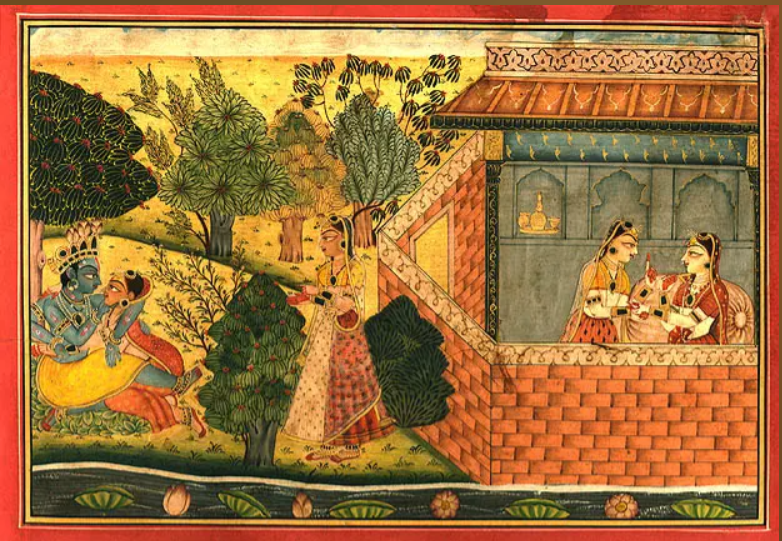
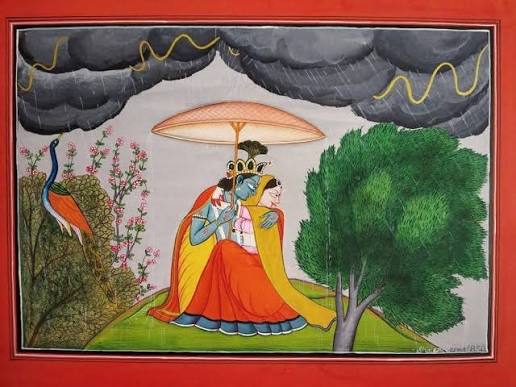
Classical Sanskrit poetics classified the beloved into eight recurring conditions, and Basohli's painters used this scheme as a working vocabulary. A Vasakasajja is shown dressed and waiting for her lover; a Virahotkanthita, anxious and restless in separation; a Khandita, confronting a lover who has strayed; an Abhisarika, braving a stormy night to keep a secret meeting. Each type prescribed its own gesture, its own companions, its own hour and weather, so that a painter reading a verse already knew exactly which scene to build.
Ornament as illusion
Jewellery in a Basohli painting is not simply drawn — it is built up in relief. Pearls are rendered as raised dots of thick white paint, given a rounded, tactile presence rather than a flat outline. For emeralds, painters embedded tiny cut fragments of iridescent jewel-beetle wing case directly into the wet paint of a crown, necklace or armlet, so that the ornament genuinely catches and throws light as the viewer moves — a shimmer meant to evoke darshan, the idea that a devotee does not simply look at a sacred image but is met by its gaze in return.
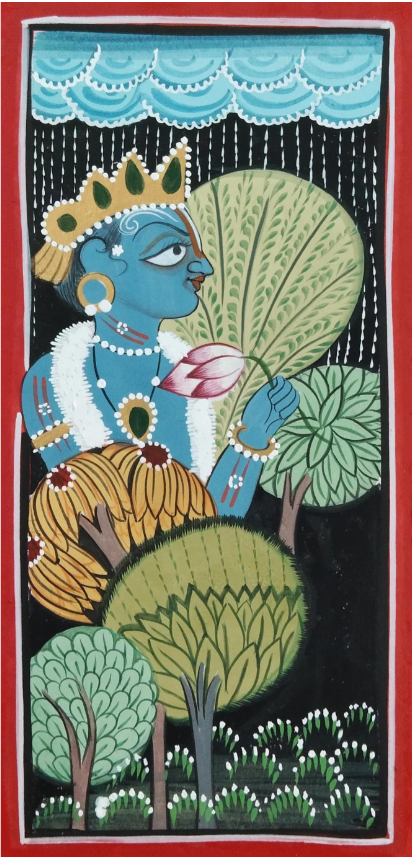
The chromatic register
The palette favours flat, unmodulated planes of colour rather than gradual shading — a deep ochre-yellow, a warm brown, or a saturated green most often fills the ground of a painting, almost always framed by a bold red or maroon border that marks the outer edge of the picture the way a threshold marks a room. Horizons sit high on the page, compressing depth to a narrow strip of sky, so that the principal figures loom close to the picture plane, immediate and unavoidable.
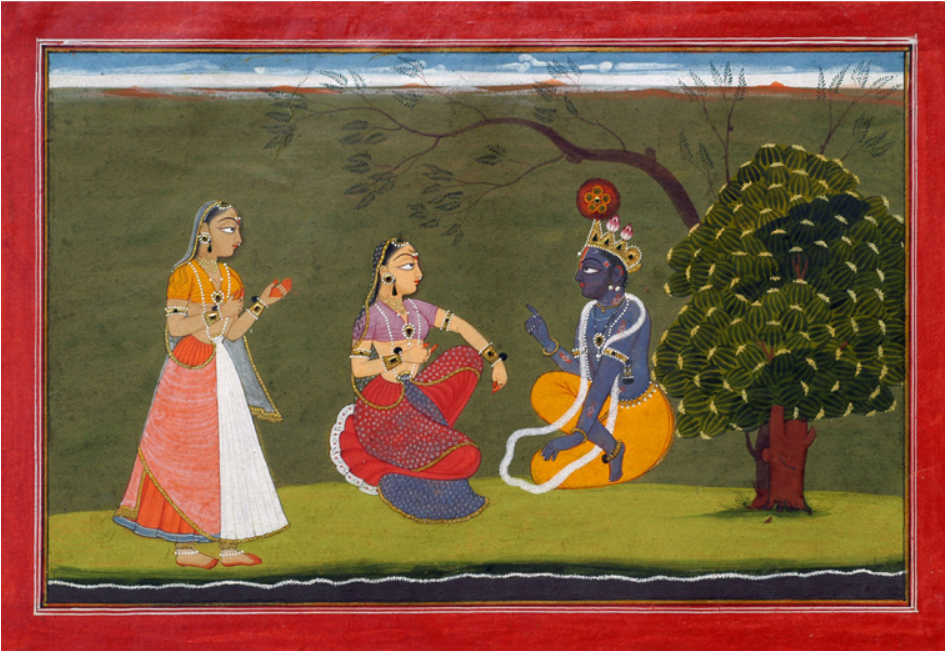
Spatial compression
Architecture and landscape are kept shallow and schematic — a single flowering tree, a low terrace wall, a curl of cloud — so that the composition reads less as a deep, receding world and more as one arrested gesture, staged right at the surface of the page. This closeness is deliberate: it keeps the viewer's attention on the single emotional instant the verse describes, rather than on any wider narrative setting.
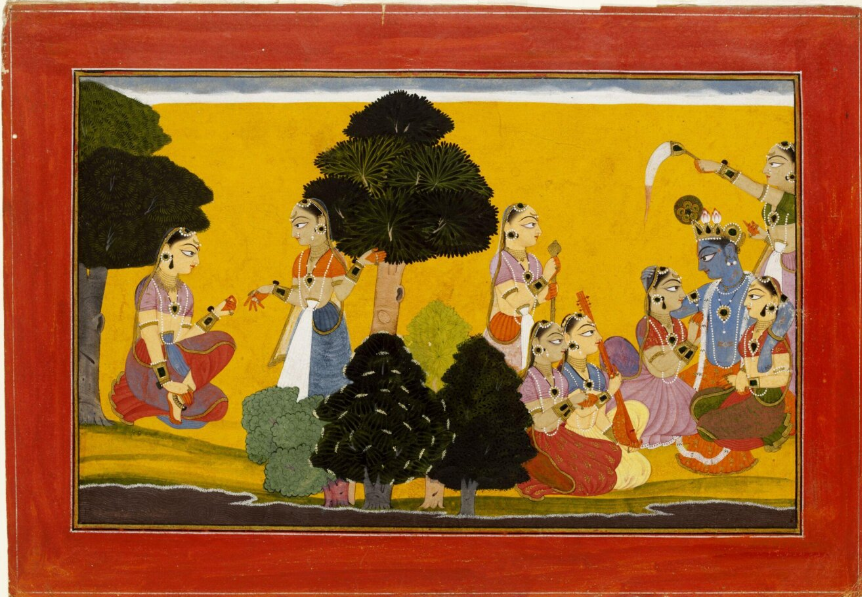
Material Anatomy & Process
- The canvas (Sialkoti wasli). Sheets of handmade cotton-rag paper were pasted together in layers to build a stiff, absorbent ground, then burnished with a smooth stone until the surface took on a cool, almost ivory-like sheen fit to hold fine detail.
- Natural mineral and plant pigments. Painters ground khadiya earth for warm ochre-yellows and browns, malachite and terra verde for the deep greens of foliage, lapis- and indigo-based blues, and lac or red ochre for the maroon grounds and borders that frame almost every composition, with fine lampblack reserved for contour and outline.
- The jewel-beetle inlay. A technique close to unique to Basohli's earliest atelier — the wing cases of the jewel beetle, cut into small fragments, were pressed into wet white pigment to stand in for set emeralds. It is most common in work from roughly 1660 to 1700, and rarely seen once the tradition matured.
- The squirrel-hair brush. The finest linear work — an eyelid, a jewelled thread, a single eyelash — was laid down with brushes of one or two squirrel hairs set into a bird's quill, alongside gold and silver leaf reserved for borders and regalia.
The Literary & Spiritual Roots — the poetry behind the painting
- Bhanudatta's Rasamanjari. The school's founding text is a Sanskrit poem by Bhanudatta, a Maithili poet — its title meaning "a bouquet of rasa", the essence or flavour of aesthetic feeling. The poem is built almost entirely as a catalogue of nayaka-nayika bheda, a classification of lovers and their emotional states, exploring verse by verse exactly how longing, jealousy, anticipation or reunion each carry their own distinct flavour.
- Verse made visible. Around 1680–95, Kirpal Pal's atelier — Kripal, Devidasa and Golu, three generations of one family — set out to give Bhanudatta's verses a pictorial form. In doing so they made one decisive change: the poem names no particular hero, but the Basohli painters recast its anonymous lover as Krishna, and his beloved as Radha. Each folio is, in effect, an illustrated stanza — one verse, one mood, one scene — so that the painting does not narrate a story so much as illuminate a single line of poetry.
- The ashta-nayika as poetic vocabulary. The eight classical heroine-types gave the Rasamanjari series its working structure. A verse describing the Kalahantarita, parted from her lover after a quarrel, or the Vipralabdha, deceived and left waiting through the night, told the painter precisely which gesture, which companion figures and which hour of the day the scene required — poetry supplying the stage directions the brush then followed.
- Beyond the Rasamanjari. In the decades that followed, the same court idiom was carried onto other verse — the twelfth-century Gita Govinda of Jayadeva, episodes from the Bhagavata Purana, and the Ragamala poems, in which each musical mode, or raga, was given a personified, seasonal scene of its own on the page.
- The devotional turn (madhurya bhava). By placing Krishna and Radha inside Bhanudatta's love poetry, the Basohli atelier let a single verse be read two ways at once — as courtly romance, and as bhakti, the soul's own longing for the divine. A folio of aching separation became, in the same brushstroke, both a picture of heartbreak and a picture of prayer.
Heritage, Lineage & Field Notes
- The painter's lineage. The atelier that founded Basohli painting stayed within one family across three generations — Kripal, his son Devidasa, and Devidasa's son Golu — working under successive rulers of Basohli through the late seventeenth and early eighteenth centuries. A branch of the same family, based for a time in Nurpur, carried the idiom forward into later work on the Gita Govinda.
- Geographical Indication status. In April 2023, Basohli Painting was granted the GI tag, registered through NABARD's Jammu office as part of a wider effort begun in December 2020 to secure protection for nine craft traditions of the Jammu region. It was the first time a Jammu-region handicraft received such protection, formally recognising Basohli Painting, centred on Kathua district, as a distinct and geographically rooted heritage craft.
- Archival repositories. Dogra Art Museum, Jammu — home to one of the most significant surviving Rasamanjari sets from the original atelier; Bharat Kala Bhavan, Banaras Hindu University, Varanasi; National Museum, New Delhi; Museum of Fine Arts, Boston, holder of one of the earliest known Rasamanjari series, dated to around 1680; and the Metropolitan Museum of Art, New York, along with the Cleveland Museum of Art, San Diego Museum of Art and LACMA, each holding individual Basohli folios.
A verse written for the ear was given a face, a room, a season and a colour.